Risk Management in Business

Our team of experts tailors strategies to your business’s specifics, providing optimal protection against operational, financial and strategic risks.
Successful entrepreneurship requires not only bright ideas, but great courage. Understanding your market, your assets, ins and outs of your goal will help you make smart decisions when it comes to risk-taking.

Risk identification and mitigation

Taking risks can definitely lead to success— as long as you’re taking the RIGHT risks. For example, if you have approved and signed a long-term lease contract for an enormous office space, COVID-19 most likely made it excessive. Funds invested into renovation appeared to be wasted, because most of staff would be transferred to a remote work. If you haven’t explored this option at least partially for a limited number of employees in the past, that may be a viable risk to take. Moving to another (lesser) location, on the other hand, maybe too much of a financial risk (due to a lease contract T&Cs) at this point in time, and would take further exploration and forecasting to see if it’s viable.

The truth is we are faced with possible risks in and out of our careers all throughout our lives. Some of the positive risks come true, while others (negative) may also happen and might push us to the brink of bankruptcy. What’s important is looking at the pros and cons of the risk you’re considering and understanding if it will ultimately get you ahead.

Be inspired and excited to take risks while also keeping the health of your company at the forefront of your mind. Instead of being discouraged or aimlessly moving forward, you can instead work as a calculated
Risk-Taker, who carefully takes steps toward your goals. Develop risk response mechanisms in the company's financial model, and you will better understand both the causes of risks and the likely financial resultes that will arise from the occurrence of predicted events. Risk is inevitable, but by understanding that you can find ways to reduce unnecessary risk in your business you may develop a risk management plan.

How to develop Risk Management Plan

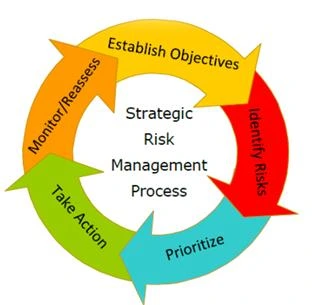
There is no Universal Risk Management Plan. It MUST be developed for each unique company and will differ for every business. More than that, it is meant to be adjusted and improved over time. At the same time, overall life cycle approach outlines the sequence of logical phases that can be iterated and you are supposed to come through in each case of Risk Management Plan development. They are:
GrafFIN - Управління ризиками Краків

  • Identify risks;
  • Perform qualitative risk analysis;
  • Perform quantitative risk analysis;
  • Plan risk responses;
  • Implement risk responses;
  • Monitor risks (all the time).
Often phase of prioritization could be divided on to separate sequential sub phase – qualitative and quantitative risk analysis. Results obtained are used as the basis to determine priority of risk identified. The same story is for the phase “Take Action” (as it shown on the picture) – you plan the risk response at the beginning of the process and then, in case risk event comes true – implement preplanned response. 

Don’t forget about valuable points. Involve actively your staff in the process of Risk Management Plan development - give your employees an active role in identifying, managing, and mitigating risk. The more prepared they are, the more likely your pre-defined actions will be executed successfully.

Keep written documentation for how to deal with different types of risk and how effective the plan was when those risks occurred.

Remember: Risk management is not about the complete elimination of risk. Risk can benefit businesses by creating unique opportunities, and risk effective management can increase efficiency of company management in a way that delivers improvements throughout the operation.

The way you manage risk can make the difference between success and failure of a commercial enterprise.

Types of risk management and wide range of scenarios

There are generally four types of risk management. They are quite different and cover a wide range of scenarios. They are not equally appropriate for every risk assessment, but it is important to determine which technique fits better as a part of initial risk management decisions. While the choice is sometimes obvious, it is better for the business to examine risk in the context of existing systems and processes.


• Risk Avoidance – It may be appropriate in case of high priority thread with high probability of occurrence and large negative impact. In fact it means withdrawing from a risk scenario.

• Risk Reduction – Early mitigation action keeps risk at acceptable level and reduces the impact of factors that drive severity of loss.

• Risk Transfer – Risk can be reduced or made more acceptable, if it is shared or even transferred completely to the third parties - Insurance companies, for example.

• Risk Retention – Risk existence is acknowledged, accepted and accounted in budget, no proactive action is taken. It is appropriate for low-priority threads or in case it is not cost-effective to address this type of risk.


By building these four types of risk management into a culture of everyday best practices, commercial enterprises send a message to third parties that they are safe to deal with. This includes customers as much as suppliers. When entities and individuals know that their interests are a priority, the company benefits from rhythmical business and loyalty.



How right risk management can help you

Establishing an effective risk management system at your company will definitely differ positively your business from those of competitors, and we will help you in adding this valuable feature to your business.

More detailed and updated information can be found in the relevant blog articles. Welcome.
For your convenience, you can download the document "Risk Register (TEMPLATE)" in the lower part of this page, under the "Fill in the fields | Download the file" button. After filling out the form, close the tab, then you can download the template. Enjoy!
Survey -> Download