how to outsmart

Triangle of great Guru-Strategists

Triangle of great Guru-Strategists
This article continues the theme raised in two previous articles: "How Clausewitz's Principles Can Be Useful in Modern Business, Management, and Leadership" and "Clausewitz Versus Sun Tzu". The central idea uniting all three articles is to draw on the best of our predecessors, analyzing their experiences and historical legacy in the form of books, manuscripts, and treatises - no matter when or how (a brush for writing ancient Chinese characters, pen and ink, or a typewriter) great thinkers recorded their thoughts. You can find brief notes on Carl von Clausewitz, as well as Sun Tzu, in my previous articles in this series (mentioned above).

Michael Porter and competitive strategy

Now a few words about Michael Porter, renowned American researcher recognized as a leading authority on competitive strategy and economic development. As a long-time professor at Harvard Business School, he developed foundational business frameworks used worldwide to analyze industry competitiveness. Not by chance Michael Porter's theory of national competitive advantage deserves its place in this triangle. The Diamond Model focuses on the international competitiveness of specific industries within a given country. It explains why some companies in certain countries are capable of continuous innovation, while others are not. Porter argues that a company's ability to compete internationally is primarily based on an interconnected set of specific advantages that certain industries in different countries may or may not possess, namely:
Firm Strategy, Structure and Rivalry;
• Factor Conditions;
• Demand Conditions;
• Related and Supporting Industries.

Two more components often complement this model: government and chance. If these conditions are favorable, they compel domestic companies to constantly innovate and modernize. The competitiveness that develops from these conditions is useful and even necessary when entering international markets and competing with the world's largest competitors.
Together, they create a national business environment that generates new companies and creates the conditions for their competitiveness.
Трикутник великих стратегів

Strategic Triangle

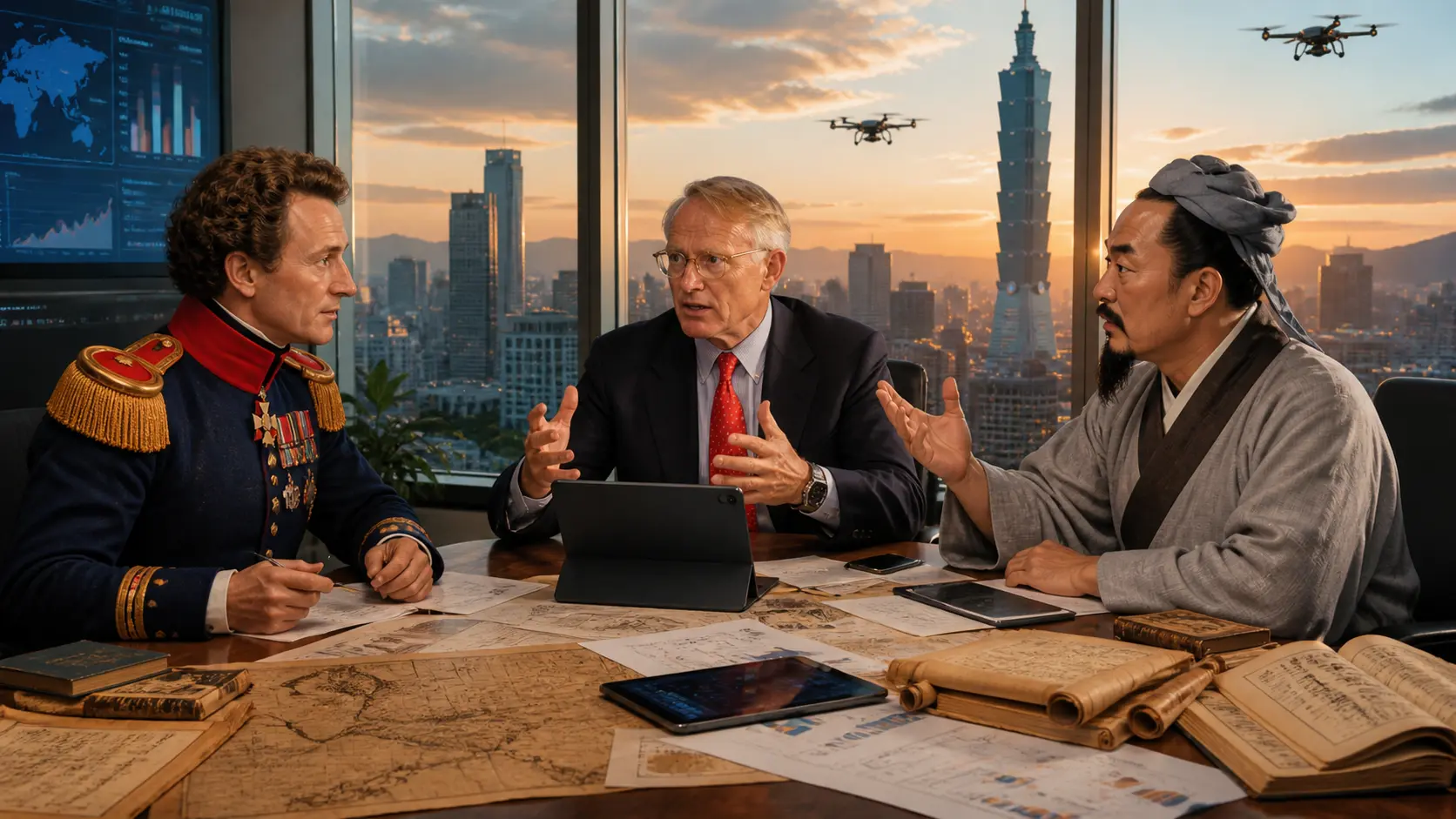
Returning to the topic, you might ask: why a triangle? Why have you chosen these three strategists from different eras and combine them? The answer is obvious: the triangle was chosen to connect classical strategy, military theory, and modern business strategy. In this article, we will examine this figure (strategic ideas triangle) from different perspectives and, using a comparative matrix, explore how modern business leaders can reap the greatest benefits by combining the insights of all these great thinkers.

Clausewitz – Sun Tzu – Porter: Strategy Comparison Matrix

1. Strategic Worldview

Dimension
Clausewitz
Sun Tzu
Michael Porter
Core domain
War between states
War as art & psychology
Competitive markets
Nature of conflict
Violent clash of wills
Contest of perception & advantage
Economic rivalry
Role of uncertainty
Central (friction, fog)
Manageable via intelligence
Reduced via analysis
View of reality
Chaotic, nonlinear
Fluid, adaptive
Structured, model-driven
Dimension
Clausewitz
Sun Tzu
Michael Porter
Ultimate aim
Impose one’s will
Win without fighting
Achieve superior returns
Relationship to policy
Strategy serves politics
Strategy serves survival
Strategy serves value creation
Success definition
Political objective achieved
Opponent psychologically broken
Sustainable competitive advantage

3. Approach to the Opponent

Dimension
Clausewitz
Sun Tzu
Michael Porter
View of opponent
Equal, resisting will
Deceivable, shapeable
Rational competitor
Relationship to policy
Decisive engagement
Indirect approach
Positioning vs rivals
Preferred interaction
Often unavoidable
Avoid if possible
Minimize destructive rivalry

4. Key Strategic Concepts

Thinker
Core Concepts
Clausewitz
Friction, Schwerpunkt (COG), Moral forces, Decision, Will
Sun Tzu
Deception, Intelligence, Timing, Shi (), Adaptability
Porter
Five Forces, Value Chain, Trade-offs, Fit, Positioning

5. Role of Leadership

Dimension
Clausewitz
Sun Tzu
Michael Porter
Ideal leader
Strong will + judgment
Wise, subtle, patient
Rational architect
Decision style
Decisive under uncertainty
Situational, indirect
Analytical, structured
Moral authority
Critical
Important
Secondary

6. Information & Intelligence

Dimension
Clausewitz
Sun Tzu
Michael Porter
Information quality
Always incomplete
Can be made superior
Largely obtainable
Intelligence value
Important but limited
Decisive
Input to analysis
Reaction to ambiguity
Act despite it
Exploit it
Reduce it

7. Time & Dynamics

Dimension
Clausewitz
Sun Tzu
Michael Porter
Time horizon
Campaign-dependent
Continuous adaptation
Long-term positioning
Speed
Critical at decision points
Essential for advantage
Less emphasized
Change
Inevitable escalation
Constant flux
Industry evolution cycles

8. Use of Force / Resources

Dimension
Clausewitz
Sun Tzu
Michael Porter
Resource logic
Concentrate at decisive point
Win with minimal force
Optimize allocation
High
Avoided
Managed via trade-offs
Cost of conflict
Accepted
Minimized
Avoided if value-destroying

9. Strategy vs Operations

Dimension
Clausewitz
Sun Tzu
Michael Porter
Strategy–tactics link
Deeply intertwined
Highly fluid
Clearly separated
Execution emphasis
Critical
Elegant simplicity
Operational effectiveness strategy
Failure source
Friction, misjudgment
Poor intelligence
Imitation, lack of fit

10. Business & Leadership Application

Context
Best Framework
Crisis leadership
Clausewitz
Market entry analysis
Sun Tzu
M&A / hostile competition
Porter
Platform competition
Clausewitz + Porter

11. Strengths & Blind Spots

Thinker
Strengths
Limitations
Clausewitz
Realism, power dynamics, leadership
Less prescriptive
Sun Tzu
Adaptability, intelligence, efficiency
Abstract, metaphorical
Porter
Analytical clarity, rigor
Static, weak on uncertainty

Integrated Executive Insight

So, modern leaders benefit most by combining all three:
Clausewitz
How to lead under pressure and uncertainty
Sun Tzu
How to outmaneuver competitors without escalation
Porter
How to structure sustainable economic advantage
In other words:
Clausewitz
How to lead under pressure and uncertainty
Sun Tzu
tells you
Porter
where to compete
I am confident you will find maximum benefit from these matrices, which will suit the unique combination of your business conditions. More articles, focused on business strategy development and strategy implementation, you can find at our blog. Welcome.